Start by identifying the role of the document
ASTM footwear documents do not all do the same job. Some describe controlled laboratory test methods. Others state performance requirements for a product category. Record the complete designation and edition shown in the exact model documentation before comparing footwear.
| Document | Primary role | Buyer question |
|---|---|---|
| ASTM F2412 | Foot-protection test methods. | Which property was tested and under which edition? |
| ASTM F2413 | Requirements for protective safety-toe footwear. | Which categories appear in the complete marking? |
| ASTM F2892 | Requirements for soft-toe protective footwear. | Does the model omit a protective safety toe? |
| ASTM F2913 | Whole-shoe coefficient-of-friction test method. | What exact test data and conditions are reported? |
| ASTM F3445 | Slip-resistance performance requirements. | Which model and test conditions are covered? |
| ASTM F3751 | Footwear water-resistance test method. | What water claim, coverage and limit are documented? |
Keep the standard edition with the number
The year suffix matters because requirements, terminology and marking formats can change. Do not silently replace the edition cited by a workplace specification, purchase contract or product record. Resolve differences with the responsible safety or procurement authority.
Decode the complete ASTM marking
| Code | Protection idea | What to verify |
|---|---|---|
| I/75 | Toe-area impact resistance rating. | Complete marking, standard edition and exact model. |
| C/75 | Toe-area compression resistance rating. | The rating shown for the precise configuration. |
| Mt | Metatarsal protection for the upper foot. | Presence and rating where the workplace requires it. |
| EH | Electrical-hazard protection for specified accidental-contact conditions. | Designation, standard, condition and workplace procedure. |
| SD | Static-dissipative properties. | Required resistance category and static-control program. |
| PR | Puncture resistance of the footwear bottom. | Underfoot marking and exact-model documentation. |
Use a six-step reading sequence
- Identify the standard. Record the complete ASTM document printed or documented for the model.
- Identify the edition. Keep the year suffix with the standard number.
- Read toe ratings. Confirm impact and compression instead of relying on a material name.
- Read optional categories separately. Metatarsal, puncture, electrical and static claims answer different questions.
- Match the exact product. Confirm model, SKU, colour and configuration.
- Match the workplace. Compare every required category with the employer assessment and purchasing specification.
Stop and request more documentation when
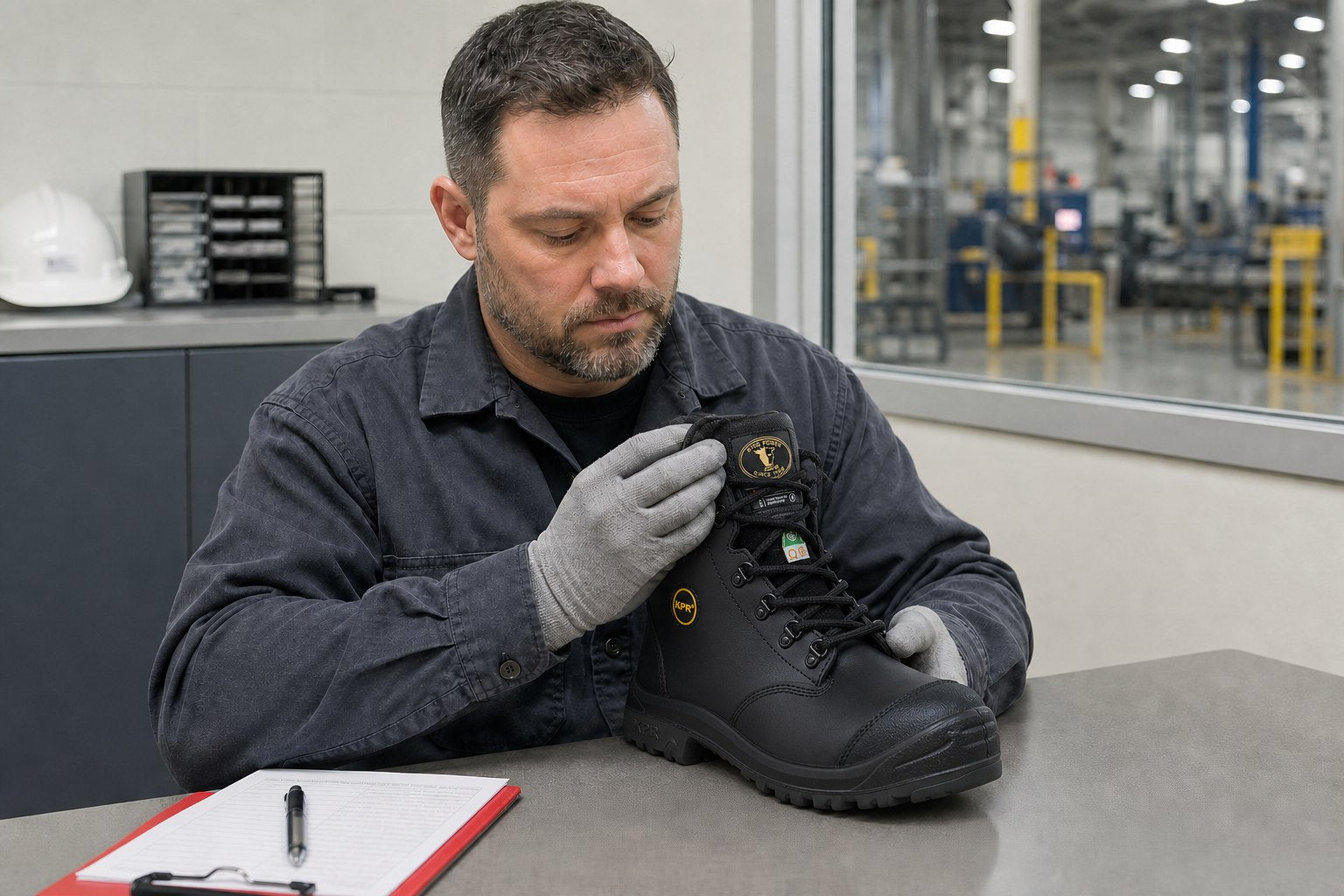
- The permanent marking is incomplete, unreadable or inconsistent with a sales description.
- The required edition differs from the cited edition.
- The workplace needs a category that is not clearly present.
- The record belongs to a different colour, width, SKU or configuration.
- Original components have been changed or the footwear condition is uncertain.
Official reference
Review the official ASTM F2413 scope and current edition and the applicable purchased standard. The complete marking and exact-model documentation remain the basis for the product check.